


Uzbekistan had fascinated me for years before I finally visited. It’s a country where Silk Road history, stunning Islamic architecture, and beautiful textiles all come together.
Last October, I spent two weeks solo-travelling around Uzbekistan by train, exploring ancient cities, eating my way through the markets and, let's be real, spending plenty of time searching for textile treasures.
Side note: I do think Uzbekistan is a very solo-traveller-friendly country, even as a woman. I've felt less safe in London and New York than in any Uzbek city. English is becoming increasingly more common, especially in Bukhara and Samarkand, and it's incredibly easy to get around.
In reality, you could easily experience the highlights in 10 days, especially since several of the historic cities are quite compact. The high-speed rail network (Afrosiyob) also makes travelling between them surprisingly easy. Make sure you book your trains in advance (I believe dates are usually released 6 weeks in advance), as they do sell out. You can book tickets online through the official Uzbekistan Railways website or the mobile app.
This itinerary takes you along the classic Silk Road route through Tashkent, Khiva, Bukhara, and Samarkand, with lots of chances to discover traditional Uzbek suzani textiles.
If you love colour, craftsmanship and centuries-old markets, I'm sure you'll fall just as in love with Uzbekistan as I did!
Day 1–2: Tashkent (1 or 2 nights)
Most international flights land in the capital, so Tashkent is the natural place to start your trip. It’s a fascinating city shaped by Soviet brutalist architecture, ancient trade routes, and today’s budding Uzbek culture, including an increasingly attractive restaurant and art scene.
Arriving in a new place can feel a bit intimidating, especially late at night. Since I landed around midnight, I pre-booked a transfer to my hotel using Welcome Pickups. It costs a bit more than grabbing a taxi at the airport, but I think the peace of mind is worth it. I stayed at Ateca Hotel Suites, which is in a great location near the Ming O’rik metro station.
Begin your visit by exploring the Tashkent Metro, which is, by far, one of the most beautiful subway systems in the world. Each station has its own unique style, with chandeliers, mosaics, and marble interiors. It’s also super easy to navigate, using a colour system. Some of my favourite stations were Mustaqilik Maydoni, Gafur Gulom, Alisher Navoi, and Bodomzor.
Getting off at Chorsu station, take your time to wander through the stalls and levels of Chorsu Bazaar, a large domed market where locals buy spices, fresh produce, and traditional foods. It’s a great place to enjoy the atmosphere and sample local snacks. The sellers are extremely welcoming to foreigners and are eager to share their culinary heritage.
One thing you cannot miss, which is ubiquitous in markets, hotels and restaurants alike, is Uzbek bread. Baked in round shapes in a tandoor oven, it's chewy on the outside and soft in the middle, sort of similar to the texture of a bagel, and delightfully salty (but not too much). These round loaves are not only delicious but are beautiful, like art.
Beyond the food area of the Chorsu Bazaar, you can also find all sorts of other essentials, household goods, and textiles in the outer sections.
For those interested in craftsmanship, the Museum of Applied Arts in Tashkent is a must. The building itself is stunning, filled with carved wood, painted ceilings and rooms showcasing traditional embroidery, ceramics and textiles. Their antique suzani collection is mesmerising!
Other worthwhile stops include:
-
The Memorial to the Victims of Political Repression gives insight into Uzbekistan’s complex history. Be sure to get a tour guide here unless you speak Uzbek or Russian, as the information isn’t available in English.
-
Amir Temur Square, home to the iconic Hotel Uzbekistan
-
Ko’kaldosh Madrasasi and Hoja Ahror Valiy Mosque (very close to the Chorsu Bazaar)
No visit is complete without trying plov, Uzbekistan’s famous rice dish with lamb, raisins, carrots, and spices. I had a great one at Restaurant Caravan.
Day 3–4: Khiva (2 nights)
Khiva feels like walking into a perfectly preserved Silk Road movie set.
You can reach Khiva by flying to Urgench and driving for about 40 minutes (which saves you a bit of time), or by taking the overnight train from Tashkent (which is an experience in itself!). Once you arrive, stay inside the historic walled city of Ichan Kala, which is like an open-air museum. I stayed at the Polvonnazir Guest House, which has fantastic views and an even better breakfast. The hosts just kept bringing out plate after plate of fruit, nuts, eggs, and various pastries and sweets!
The old city is quite compact and small enough to explore on foot, which makes it great for wandering and taking photos. If you want to avoid the crowds, I'd recommend getting up early to walk around, just after sunrise at about 8am, since most tour groups arrive around 9 or 9:30am.
Definitely bring layers, too. Don’t be fooled by thinking deserts are always hot, like I was. I was there in October and practically wore everything in my suitcase one morning when it was 4 degrees Celsius - it later warmed up to 25 degrees Celsius!
Highlights include:
-
Kuhna Ark, the former citadel of Khiva’s rulers
-
Climbing the Islom Khoja Minaret for sweeping views over the old city
-
Afternoon tea (they have an excellent menu here for fruit infusions) or a sunset drink at Terrassa Café, overlooking the rooftops
-
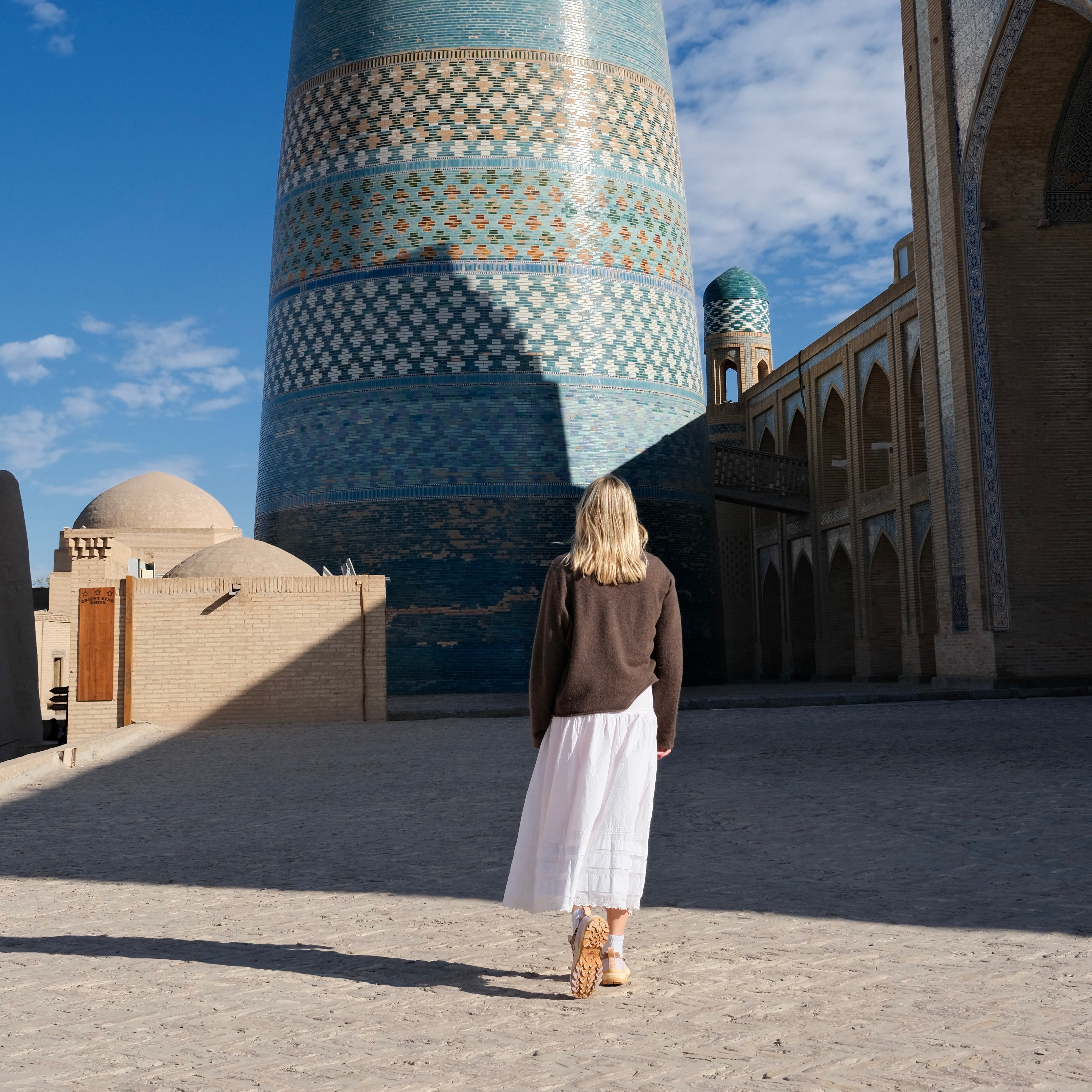
The famous Kalta Minor Minaret, a turquoise-tiled masterpiece that you’ll probably want to photograph again and again. I probably have 300 photos of it!
You also can't visit Khiva without trying Shivit Oshi, a green noodle dish topped with beef stew. To make the noodles green, a healthy amount of dill is mixed into the dough, which also adds a zingy flavour that pairs well with the savoury stew and dollop of sour cream on the side. I had a great one at Arxi Terrassa.
Khiva has many small workshops where artists make traditional textiles and handicrafts. The Allakuli Khan Tim Market offers a wide selection of new suzanis and crafts for sale. Even if you’re not planning to buy anything, it’s a great place to learn about the region’s craft traditions. If you're after something with a bit more patina, many souvenir shops also have stacks of vintage suzanis if you look toward the back or ask politely.
Day 5–7: Bukhara (2 or 3 nights)
From Khiva, take the train to Bukhara, which takes about 7 hours. Bukhara is one of the most atmospheric cities in Central Asia. If you have time, I suggest spending at least three days here to really enjoy its history and feel.
The old city is filled with hidden courtyards, historic madrasas, and shaded squares where locals gather for tea. I was lucky to visit during the Bukhara Biennial, so many old buildings and madrasas were open to the public for the first time, with exhibits across every medium imaginable from international artists.
I recommend staying in one of the beautiful family-run guesthouses in the old town. I stayed at Art Suzani, which overlooks the Kalan Minaret. Many of these guesthouses are converted merchant houses with carved wooden columns and quiet courtyards.
Architectural highlights include:
-
The Kalan Minaret, which has dominated the skyline since the 12th century
-
The grand Po-i-Kalan complex
-
Bukhara Ark, which has a history that spans thousands of years
-
The charming Chor Minor, known for its four turquoise domes
-
Sitori-i-Mokhi Khosa Palace, once the summer home of Bukhara’s Emir, is full of painted ceilings, collected furniture, and has the most beautiful antique suzani collection I’ve ever seen in the old Harem.
I highly recommend hiring a guide for a full day. Without one, you’ll see many beautiful buildings but will likely miss out on the fascinating history behind them.
If you love textiles, Bukhara is a dream. The city is known for silk ikat and suzani embroidery. Several workshops let you watch artisans draw their designs and stitch using techniques passed down for centuries. Some will even show you the step-by-step process, starting from the silk worms munching on mulberry trees.
Don’t miss:
-
Visiting a suzani workshop to learn about the craft. I recommend the one right next to Toqi Zargaron, very centrally located.
-
Browsing the historic Tim Abdulla Khan trading dome, once part of the Silk Road marketplace network
-
Stop by my friend Mirzo’s shop (@bukharaold) in Abdulaziz Khan Madrassah. He has some of the most beautiful vintage and antique pieces you’ll find!
-
The family that runs Art Suzani also has its own suzani shop in Ko’kaldosh Madrasasi, which is well worth a visit if you’re on the hunt for embroidery.
One of my favourite places in the city is Lyabi Khause Square, centred around a peaceful pool and surrounded by cafés. It’s perfect for people-watching with a cup of tea after a day of sightseeing. I had great meals in Bukhara at Zolotaya, Sitora Kafe, Ayvan, Magic House, and lovely pick-me-ups at Donuts and Coffee.
If you have extra time during your trip, spend it in Bukhara. You won’t regret it!
Day 8–9: Samarkand (2 nights)
Next, take the train from Bukhara to Samarkand, which takes about four hours. Samarkand is probably Uzbekistan’s most famous city, as it once held a prominent place as one of the capitals of the Islamic world.
Samarkand’s architecture is truly impressive. The monuments were built to amaze traders travelling the Silk Road. The highlight is Registan Square, a huge plaza surrounded by three stunning madrasas covered in intricate tilework. It’s one of Central Asia’s most iconic sights.
Other essential stops include:
-
Bibi-Khanym Mosque, once one of the largest mosques in the Islamic world
-
Shah-i-Zinda, a stunning necropolis that many call the most beautiful cemetery in the world
If you love markets, be sure to visit Siyob Bazaar, right next to Bibi-Khanym. You’ll find plenty of fresh fruit, spices, nuts, and traditional breads.
Samarkand is also a great place to look for antiques and textiles. One of the most memorable shops is Haydar’s antique store, which is full of vintage ceramics, embroidery, and other treasures. I ran out of time and energy, but I’ve heard you can also find vintage suzanis at the Urgut Bazaar, a short drive from Samarkand (only on certain days of the week, so ask your hotel/guesthouse for more information before going).
For a real local food experience, try lunch at a small family-run spot just off one of the main streets. On Google Maps, it’s called ‘Halisa, Samsa, Shurpa (fresh home cooking)’. They only serve a few dishes each day. I had halisa, a wheat-and-meat porridge, and shurpa, a lamb stew. Both were incredibly delicious.
To end your visit, have dinner at Boulevard Restaurant, a great place for a relaxed evening after sightseeing. It’s also a bakery with excellent croissants. I also had delicious Georgian food at Gruzinka Restaurant for something a little different.
Day 10: Return to Tashkent (1 night)
The high-speed train makes it easy to get back to Tashkent in about two hours, depending on which service you take.
If you have time before your flight, try to fit in one last market visit for a final textile find or buy a loaf or two of round bread to smuggle home in your suitcase. If you’re like me, you’ll probably leave Uzbekistan with more embroidery than you expected, and a newfound love for Uzbek bread!


