


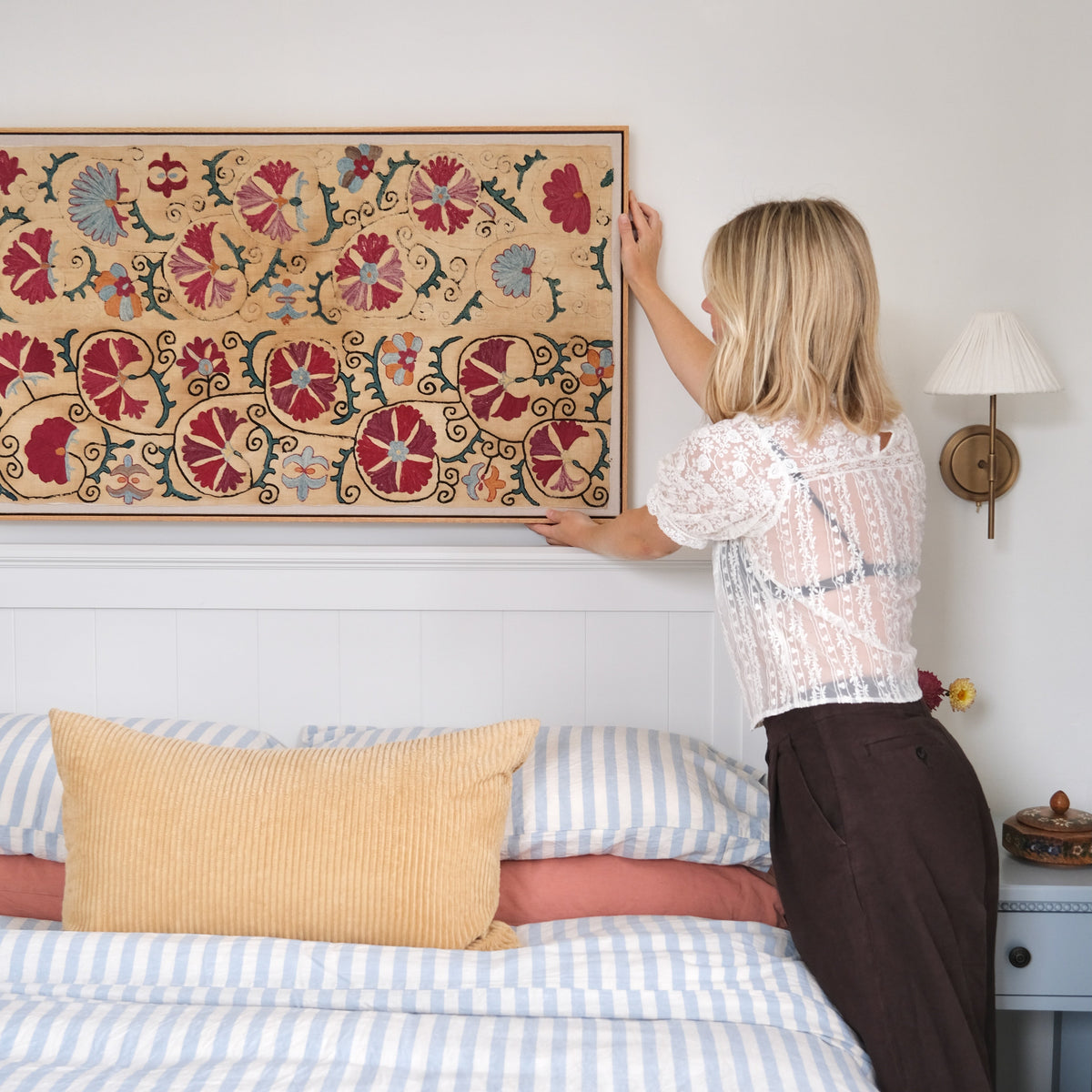
I’ve always wondered why textiles aren’t seen as art in their own right.
Handmade textiles have amazing and distinctive composition, colour, craftsmanship, and history. But while we often frame and display paintings and prints as art, textiles usually end up as soft furnishings or simple decorations.
I think we’re overlooking something special.
Presenting a textile in a considered frame doesn’t just change how we see it; it gives it a new context. It allows us to appreciate the intricacy of the design, the skill behind every stitch and the stories woven into its fabric, while helping to protect and preserve the original piece.
At Suze Studio, I specialise in transforming vintage and antique textiles, particularly Uzbek suzanis and traditional embroideries, into framed textile art. For me, it’s about celebrating these remarkable pieces and making them easier to appreciate in contemporary homes.
Here are five reasons why I think framed textiles are one of the most underrated forms of wall art.
1. They’re an antidote to mass-market monotony
These days, it’s easy to end up with the same mass-produced prints and posters as everyone else. But your home deserves something more unique.
There’s nothing wrong with prints. But if you want your space to feel truly personal, start by collecting objects that have their own stories.
Handmade textiles give you something mass-produced art can’t: the unique touch of her maker. Each piece has its own stitching, colour choices, and details, so no two are ever exactly alike.
Age also gives vintage and antique textiles an inimitable patina. Colours soften over time, vibrant fabrics fade into more muted tones, and tiny repairs show the years of use and care. These aren’t imperfections to be disguised, but details that give each piece its own character. An antique Uzbek suzani, for example, might have been embroidered by hand over many months, or even lovingly mended or added to by different women in the family over the years, creating wonderful idiosyncrasies.
Framed textile art lets you bring that uniqueness into your home. Instead of picking art just to match a trend or colour scheme, you can choose something you truly love and know you won’t see on anyone else’s wall.
2. They bring a different kind of texture and depth to a room
Embroideries, like Uzbek suzanis, have a real texture that changes as you move around them, unlike prints or paintings. Silk threads shine, raised embroidery stands out, and the fabric’s small details catch the light differently throughout the day.
Especially when paired with an open frame, this tactile quality adds softness and depth to a room, which is hard to get with other wall art. Even with simple colours, the mix of thread, fabric, and shadow adds visual interest without taking over the space.
Textiles also help soften the hard surfaces you often find in modern homes. Next to plaster walls, wood, stone, or metal, embroidered art brings warmth and balance.
And you don’t necessarily need a brightly coloured piece to achieve this. A more muted antique embroidery can add just as much interest because of its texture, tonal variations and intricate detail.
3. They bridge the gap between old and new
The interiors I love most strike a balance between old and new. They bring together objects from different eras, materials and places to create something that feels personal rather than trend-led.
Framed textiles are a beautiful embodiment of this idea.
An antique textile may have been made generations ago with skills passed down in families, but it can still look right at home in a modern space.
You don’t have to live in an old house or have classic decor to enjoy an antique suzani. In a simple frame, an antique textile fits well with modern furniture. I’ve got one at home sitting happily right next to a very modern Danish design lamp.
I love this contrast between the intricacy of an old textile and the clean lines of a modern frame. The frame provides a considered structure without competing with the original design, allowing the colours, embroidery and character of the fabric to take centre stage.
For me, it’s about balancing respect for the past with how we live today. Framed textile art lets these pieces of history become part of modern homes, instead of being kept only in museums, drawers, or antique shops.
4. They’re a celebration of women’s art
Nothing frustrates me more than when women’s creations are reduced to “crafts”.
Traditional embroideries such as Uzbek suzanis are extraordinary expressions of women’s creativity, skill and artistic vision. Historically, suzanis were often made for domestic and family use, including for a woman’s dowry, marriage celebrations and the establishment of a new household. Their creation could involve women working together, with embroidery skills and designs passed between generations.
These textiles are not simply decorative objects. They embody knowledge, symbolism and traditions that have developed over centuries. Their colours, motifs and compositions reflect the creativity of the women who made them, as well as the cultural contexts in which they were produced.
But art made by women, especially for the home, has often been overlooked. Embroidery is still often called a craft, as if the skill and individuality needed to make a beautiful textile make it less important than a painting.
I think we need to challenge that idea.
Framing an embroidered textile helps us see it differently. It encourages us to notice its design, skill, and artistic value, while also respecting the culture it comes from.
At Suze Studio, this is a big reason why I work with traditional textiles. I want to celebrate women’s art and make it easier for people to find, enjoy, and live with. By hanging these pieces on our walls, we honour their beauty and the people, skills, and stories behind them.
5. They make a home feel collected, not decorated
The most interesting homes don’t come together overnight. They evolve over time, shaped by what we find, where we go, and the things we fall in love with.
A framed textile brings something unexpected to a collection of artwork, vintage finds and favourite objects. It adds another layer of colour, pattern and history, helping a home feel individual rather than simply decorated.
This is where framed textiles really shine. You don’t need a big space or budget for a large suzani wall hanging. Small framed pieces can be just as eye-catching. I especially enjoy seeing textiles mixed with other art. An embroidered suzani can add a new energy to a gallery wall, breaking up paintings and prints with its pattern and texture. If you have the room, a bigger framed textile can also be a great centrepiece above a sofa, bed, or sideboard.
Since every vintage or antique textile is unique, choosing one feels more personal than buying several prints to fill a blank wall. You’re choosing something that speaks to you, whether that’s its colours, design, history, or symbolism.
At the end of the day, I think that’s what makes a home feel special. Not that everything matches, or that every object is new, but that the things around us reflect our interests, unique life experiences and individual tastes.
A framed textile can be a small but meaningful part of your home’s story.
Discover framed textile art at Suze Studio
At Suze Studio, I carefully source handmade and vintage or antique textiles, especially Uzbek suzanis, and turn them into framed art. Each piece is chosen for its unique character, carefully prepared, and set in handmade, bespoke oak frames made locally in Bristol, UK.
Explore the collection of unique framed textiles at Suze Studio.


